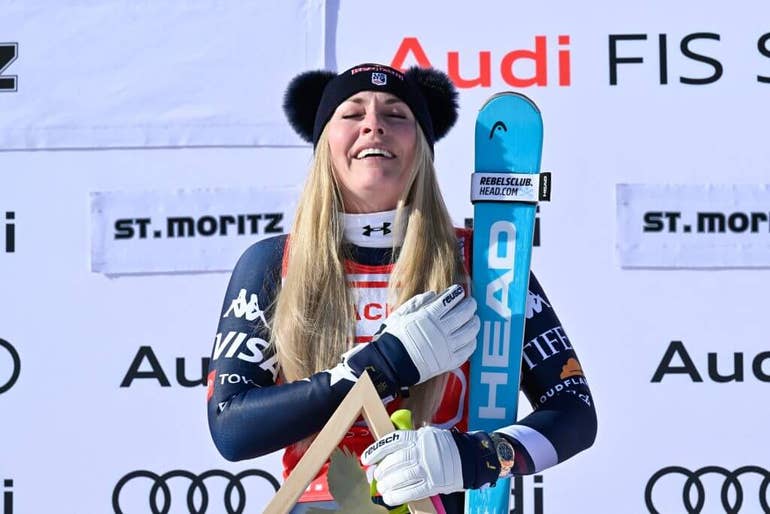
And just like that, Lindsey Vonn is back among the fastest skiers on the planet.
After five years away from competition, countless hours in the gym, a partial knee replacement, a return to familiar coaching voices, and a willingness to rethink nearly everything she once knew about her skiing, the 41-year-old has climbed back to the top of Alpine skiing.
Vonn opened what she has called her final season with a statement win in Friday’s World Cup downhill in St. Moritz, Switzerland — her first World Cup victory since March 2018. She didn’t just win; she dominated, finishing nearly a full second ahead of the field, a massive margin in downhill racing. A day later, she nearly made it two wins in a row, bouncing back from a small mistake mid-course to finish second by just 0.24 seconds. On Sunday, she added a fourth-place finish in the super-G, missing the podium by only eight hundredths of a second.
Three races. Three finishes inside the top four. With the 2026 Winter Olympics less than two months away, Vonn suddenly looks like a legitimate medal contender again.
For those who had been paying attention, none of this came out of nowhere. Throughout the fall, Vonn had been insisting she felt like her old self again — the version from before years of injuries wore her body down and forced her into retirement in 2019.
She wasn’t short on confidence even during dry training weeks in Colorado, when other skiers were limited by a lack of snow.
“I’ve figured out my equipment,” Vonn said last month. “I’m still tweaking things, but I’m fast, I’m strong, and I’m skiing well. I’m ready to race.”
She proved that point in St. Moritz.
Standing in the finish area over the weekend, Vonn was quick to credit the people around her — longtime coach Chris Knight and newly added coach Aksel Lund Svindal, a close friend and one of the greatest male downhill skiers of his era. Still, the heart of the comeback belongs to Vonn herself, particularly her willingness to abandon old habits and accept that the skier she is now doesn’t have to look exactly like the one she used to be.
For most of her career, Vonn’s size and power were seen as her biggest advantages. At 5-foot-10 with extraordinary strength, she could overwhelm courses in downhill and super-G simply by carrying more speed than anyone else. Turning was never her weakness, but raw force often stole the spotlight.
This time around, she has leaned into something different.
“My biggest strength is how I turn,” Vonn explained. “On the flatter sections, I was actually struggling to create speed, and we couldn’t figure out why.”
The answer required shedding both old habits and new equipment. Some of the gear that had followed her for years no longer suited her body. Meanwhile, newer equipment introduced during her time away didn’t quite match her skiing style either.
The turning point came after her partial knee replacement surgery in 2024. With the pain gone, Vonn no longer had to compensate in her stance. She could finally get into cleaner, more efficient positions — and that opened the door to meaningful equipment changes.
Svindal played a key role in that process. What began as friendly conversations turned into a coaching partnership over the summer. He helped Vonn make sense of what she was feeling on snow and why certain setups weren’t working.
Head, her longtime manufacturer, had developed a new boot while she was retired. Everyone else loved it. Vonn didn’t. She switched back to an older model, which helped — but something still felt off.
Through detailed discussions with Svindal, she realized why. Her body had changed. Half of one knee is now titanium. Her alignment, balance, and natural stance are different from what they were years ago. Expecting old solutions to work perfectly no longer made sense.
That realization sparked a deep dive into boot construction and alignment — minute adjustments to angles that affect how the knees track over the skis. The goal was subtle: move her knees outward by fractions of a degree to find perfect balance at 80 miles per hour.
The effect was dramatic.
“When it clicks, you know immediately,” Vonn said. “The light switch just turned on.”
She finally felt centered and comfortable again — the holy grail for downhill racers. And when Vonn is comfortable, there’s only one way she knows how to ski.
Full throttle.
That fearless, aggressive style has always defined her career. At times, it pushed her too far, especially when her body was breaking down. But now, with pain gone and balance restored, that same edge looks controlled rather than reckless.
Her coaches see it too.
“She’s not out of position like she used to be,” Knight said. “Over the last year and a half, she’s been incredibly balanced.”
Downhill skiing will always be dangerous. Injuries are inevitable. Vonn understands that better than anyone. But right now, she’s skiing with speed, confidence, and a sense of control that had been missing for years.
What everyone saw in St. Moritz wasn’t nostalgia or luck.
It was Lindsey Vonn, once again standing on the top step of the podium — exactly where she always believed she belonged.