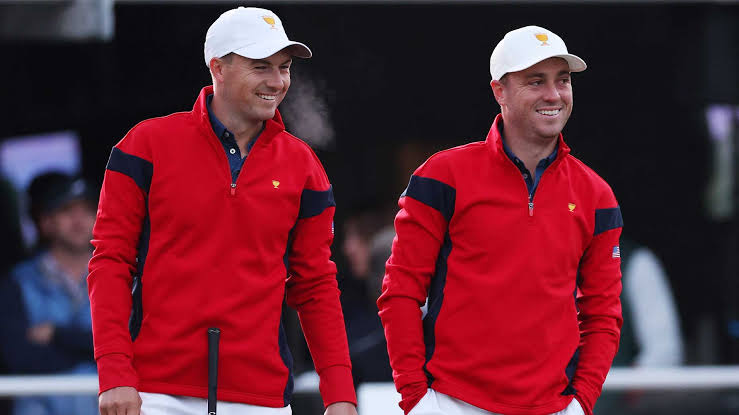
Justin Thomas has offered an honest update on his recovery after a difficult few months dealing with persistent hip and back issues. Following the 2025 Ryder Cup, the two-time major champion revealed that his discomfort worsened over the winter, eventually leading to a microdiscectomy to address a bulging disc in his lower spine. Now several weeks into rehab, Thomas says progress is steady, even if it’s slow, and he’s taking a page from close friend Jordan Spieth’s playbook.
Sharing an update on X, Thomas said he’s feeling encouraged but remains cautious. He explained that while things are moving in the right direction, he’s still not close to hitting golf balls. For him, following medical protocols and listening carefully to his body matters just as much as the surgery itself. His comments closely echoed advice Spieth recently shared while reflecting on his own injury recovery.
Spieth, who has firsthand experience with a long rehabilitation process, has consistently stressed the importance of patience. His message to fellow athletes has been simple: there’s no such thing as returning too late, but rushing back can cause real setbacks. During his recovery, Spieth even kept a journal to track small improvements, a habit that helped him recognize progress on days when it felt like nothing was changing.
That perspective carries weight.
In August 2024, Spieth underwent surgery on his left wrist after struggling with the injury for more than a year. He avoided hitting golf balls for roughly three months before easing into an extensive rehab program. It wasn’t until early 2025 that he returned to competitive play, making his advice about taking things slowly especially relevant.
For Thomas, the stakes are high. With 16 PGA Tour victories and two major titles to his name, getting healthy the right way is far more important than rushing back for an early start. His careful approach suggests he’s focused on protecting his long-term career rather than forcing a quick return.
About four weeks after surgery, Thomas shared glimpses of his rehab routine, which includes floor exercises emphasizing breathing control, core strength, glute activation, and hamstring work.
He’s following a structured schedule with rehab sessions three times a week, alternating with treatment days. While the process has been gradual, he’s said he’s happy with how things are progressing and remains committed to taking a conservative approach.
Full swings typically don’t resume until around 10 to 12 weeks post-surgery, with full returns often coming between weeks 12 and 16. As a result, Thomas has already withdrawn from December events like the Skins Game and the Hero World Challenge, and he’s set to miss the opening stretch of the 2026 PGA Tour season, including the Sony Open in Hawaii.
His decision comes after playing through ongoing hip and lower-back pain during the 2025 season , a year that still included a win at the RBC Heritage and eight top-10 finishes.
Even while sidelined, Thomas continues to make an impact beyond competition. He recently pledged $1 million to the Crimson Standard, the University of Alabama’s golf fundraising initiative, to help upgrade facilities for both the men’s and women’s teams.
A former standout for the Crimson Tide, Thomas was part of the team that won the NCAA Championship in 2013, an experience he credits as vital to his development.
Expressing his gratitude, Thomas said his time at Alabama left a lasting impression on him and played a major role in shaping his professional journey. Former coach Jay Seawell praised the gesture, calling Thomas a central figure in the program’s legacy and thanking him for giving back to the university.
Alabama women’s golf head coach Mic Potter also highlighted the broader significance of the donation, noting that Thomas’s support extends well beyond facilities and directly impacts student-athletes.
As he works his way back from back surgery, Thomas’s continued involvement in the sport, through mentorship, philanthropy, and leadership, shows that his influence reaches far beyond tournament leaderboards. Even away from the fairways, he’s finding meaningful ways to contribute to the game he loves.