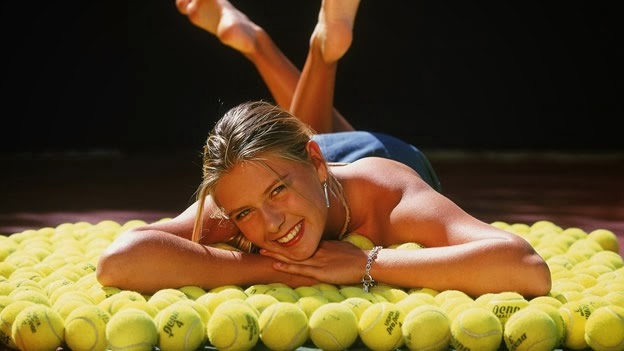
Maria Sharapova has always drawn attention for her striking looks, but it’s her tennis talent that truly sets her apart. For years, the Russian star has been chasing the No. 1 ranking. The big question: can she hold it this time?
From the start, Sharapova was often compared to Anna Kournikova. Like Anna, she emerged as a teenage tennis sensation — tall, blonde, and immensely marketable. But while Kournikova never advanced past No. 9 in the rankings or reached a Grand Slam final, Sharapova proved herself with titles. By the time she won her fourth major at Roland Garros and reclaimed the top spot, she had clearly outshined her predecessor in pure tennis ability.
Sharapova’s rise follows the classic story of great champions: early talent, dominance in youth categories, and an ability to wow both coaches and crowds. Yet her path was also shaped by extraordinary circumstances.
Her parents, Yuri and Yelena, lived in Gomel, a city deeply affected by the 1986 Chernobyl nuclear disaster. Concerned for their unborn child’s health, they relocated to Russia. There, in 1987, Maria was born. By age four, she had her first racket, and by six, she was impressing legends. Martina Navratilova urged her family to move to Florida and enroll her at Nick Bollettieri’s famous academy — a move that changed everything.
The early years weren’t easy. Maria and her father lived in the U.S. without her mother, who couldn’t get a visa at first. Money was scarce, she struggled with homesickness, and language barriers kept her out of school. Yelena joined them later and took on the role of teacher. By 14, Maria was already competing against seasoned pros, pushing opponents twice her age to the brink.
Her breakthrough came quickly. By 2002 she was making waves at Indian Wells. In 2003 she collected titles in Tokyo and Quebec, and in 2004 she shocked the world by defeating Serena Williams to win Wimbledon at just 17. That same year, she capped her season with victory at the WTA Championships, firmly establishing herself among the elite.
Sharapova first reached world No. 1 in 2005, but her reigns were often short-lived. She added more majors, including the 2006 U.S. Open and the 2008 Australian Open, but injuries in 2009 knocked her out of the Top 100. True to form, she fought her way back, reclaiming her place among the best by 2011.
Her 2012 season was a statement. She reached finals in Australia, Indian Wells, and Miami, and claimed trophies in Stuttgart, Rome, and Roland Garros. That run propelled her back to No. 1 — for the fifth time. Unlike her earlier stints at the top, this time she looked ready to stay.
At just 25, Maria Sharapova had not only proven her resilience but also cemented her legacy as one of tennis’s defining figures. With her blend of power, determination, and global appeal, her admirers had every reason to believe her greatest achievements were still ahead.